* * *

In the more recent history of that homely and hirsute hominid known as Man, we of the genus Homo have oft peered wide-eyed in marvelous contemplation of the mysterious lacuna between that which is known, and all that which remains unknown.
To find answers along the way, we have sought dialog with the winged chariot of light, the Sun, and his cold white mistress, the Moon, as they moved distantly along the ecliptic plane. We have appealed with palms uplifted to our several retreating gods and goddesses, nearly all of whom now have proven to be extinct.
Increasingly, we have employed Almighty Science to divine the true nature of our curious existence, as our smallish blue-green planet, indifferent to our perils, surfs the vast and inscrutable fabric of the space-time continuum.
In what dark corner of the world will the answers be found, lurking and waiting to be discovered?
Indisputably, the disciplines of science and mathematics have made grand advances in understanding the clockwork mechanisms of the universe since Claudius Ptolemaeus (d/b/a Ptolemy; f/k/a Claude) etched out his first naively concentric celestial ring.
We have learned much; we have traveled far on our journey of discovery. The sweeping scythe of erudition has cleared much of the dark wilderness of the unknown.
We now know, for one truly astounding example, the time that has elapsed since our universe was born from a white-hot singularity 13.75 billion years ago.
We know and understand the origins of life on Earth (more or less).
We wield subatomic particles like jacks on the playground.
We have sent rockets to planets throughout our solar system. Our men have walked on the moon, and our robots have analyzed soil samples on the surface of Mars.
Yet damnably–and undeniably–there remain a handful of scientific riddles that many scientists fear may hide forever just beyond the grope and grasp of study and cognition.
* * *
Some scientists have been known to wonder, particularly after a sufficient quantity of nicely bracing mint juleps, whether the physical makeup of the world around us–i.e., space and time and all its multivalent constituent parts–may preclude a complete understanding of the expanding universe(s) and our place in it (them).
For instance, it has been theorized that something as seemingly insignificant as, say, the mass of the Higgs boson (patent pending) may dictate whether human intelligence can accumulate the critical mass of insight necessary to span the abyss of our most mercurial mysteries.
Perhaps the most well known and sweeping scientific question is the odd discordance between relativity theory–which pertains to the physics of big-ticket items such as black holes and gravity–and quantum mechanics, which applies to the behavior of atomic and subatomic particles. Coalescing these theories into one cohesive mathematical model has proved, shall we say, maddeningly elusive.
Other daunting scientific enigmas include: how human consciousness arises (nobody’s quite sure), whether Fermat’s cryptic marginalia was a red herring (probably), and whether intelligent life has arisen on Earth (probably not).
But these classic conundrums pale in comparison to what has surely become science's true test of worth in the 21st century.
THE GOLDEN PARADOX®
Heralded like a royal throne amidst the rubble of this graveyard of comparatively trivial perplexities is perhaps the single greatest challenge facing mankind’s bold pursuit of knowledge today: an exotic puzzler known to scientists and mathematicians the world over as The Golden Paradox®.
Resolution of The Golden Paradox, which in recent decades has become the whipping boy for naysaying theologians everywhere, represents nothing less than the battle for the preeminence of science as the discipline of ultimate knowledge and understanding.
In its simplest terms, the mathematically impenetrable Golden Paradox predicts that no matter how far one stands from an American Standard™-brand porcelain urinal, a roughly equivalent amount of urine (or “urine mist”) will deflect out of the urinal and strike the feet and/or legs of the “urinator,” which is the industry term for the person using the particular urinal.
It is no mere hyperbole to say that this daunting problem has been a plague on civilized peoples everywhere since man bravely dared to release his uretero-vesical sphincter indoors for the very first time.
David H. Smith, a molecular physicist working in American Standard’s research and development facility, explains:
“At first blush, urinal mechanics appear to be squarely rooted in simple geometry, but nothing could be further from the truth. This is no mere pool-table trigonometry here. The complexity of the fluid dynamics involved in predicting the urine rebound effect is akin to the physics involved in time travel and/or manipulation the Grafenberg Spot, processes not well understood by most scientists at the present time.”
THE GOLDEN PARADOX EXPLAINED
In cultures with running water and a reliable electrical grid, it is typical for the urinator to stand with the working end of his penis more or less directly above the inside lip of the outside edge of the urinal, which places the urinator close enough to comfortably hit the urinal with a modest stream of urine, while maintaining a distance that allows any low-momentum vertical trickles falling from the penis at the end of the evacuation to also be caught by the urinal, provided the penis is not shaken violently, whipped around like a lasso in an attempt to disgorge shy or “hidden” drops of urine, or stretched to scare competitors.
However, standing in such close proximity to the urinal results in a significant amount of fine urine mist and the occasional large droplet of urine being deflected back onto the body of the urinator (the “urine rebound effect”), an unpleasant fact that is especially noticeable during warmer months when flip-flops are worn with greater frequency.
But where does the paradox come in?
Again, David Smith:
“Common experience tells us that backing up a few steps from the urinal would decrease the amount of urine mist that comes in contact with the urinator. This is not the case.
“In fact, due to certain not-well-understood equivalencies that are generated by the increased distance of urination, the level of urine mist that comes in contact with the urinator remains roughly constant regardless of one’s distance from the urinal. Thus, the paradox.”
Early classical models attributed this effect to the increased gravitational kinetic energy experienced by the arc of falling urine as a urinator moved farther from the urinal. But that’s not even close to the whole story.
As it turns out, to even scratch the surface of The Golden Paradox, one must tackle little-understood physical principles such as the continuum assumption and other cryptic formulas governing fluids (e.g., Navier-Stokes equations) that when applied in the urination context have been known to blue-screen a TI-84-Plus Silver Series Graphing Calculator out of pure mathematical fear.
For a better idea of what’s at work, see the following outline taken verbatim from an internal memorandum prepared by Smith in 1981 when his R&D team first seriously assessed the problem.
INTERNAL MEMORANDUM
* * * DO NOT COPY * * *
TO: R & D URINAL TEAM, DIV. I
FROM: DAVID H. SMITH, G.E.D., B.S., Ph.D.
RE: URINAL REBOUND PHYSICS / ADDRESSING THE "GOLDEN PARADOX"
DATE: CLASSIFIED
As R & D Urinal Team leader, I have been charged with carefully examining the frontal-lobe-mincing physics of urine spray and distribution associated with our Class-A series of wall-mounted porcelain non-sit operator-flushed urinals as part of a broad feasibility study currently underway at Am/Std aimed at reducing the amount of urine rebound presently generated in the typically prostrated American male.
As part of my examination, I have compiled a brief and certainly non-exclusive list of factors that must be scientifically considered as part of this effort, each of which will be assigned to individual groups for further study. These factors include:
1. Fluid Mechanics:
• Although well understood in an idealized setting, fluid mechanics a/k/a fluid dynamics is often charitably referred to as a black art, and I’m not talking about Horace Pippin.
• The underlying equations often assume extremely unlikely confluences of idealized parameters.
• The equations are nearly always expressed in the language of differential calculus (gradients, divergences, and curls), all of which is non-intuitive to anyone but a Hawking-level savant.
• Small variations in input parameters can have large, unintended effects on macroscopic quantities of interest, e.g., flow velocities.
2. Surface Tension.
• A ‘ribbon of urine’ is not actually a ribbon. If it were, the situation and accompanying equations would be much simpler.
• In actuality, surface tension causes your urine stream to dissociate into a large array of smaller droplets.
• Many components in your typical urine sample can significantly alter the surface tension: (i) ammonia content; (ii) sugar; (iii) asparagus.
• Different-sized droplets will respond differently to wind and gravity. Caveats: (i) you cannot automatically assume that gravity will contribute significantly to the equation; (ii) small droplets achieve terminal velocity relatively quickly; (iii) the kinetic energy of the stream may be at a maximum right at departure from your sadly shriveled unit.
3. Exit-flow Characteristics.
• Exit-flow ratios can vary dramatically on a continuum from “leaky faucet” to extreme urgency or “12-pack” a/k/a “liquor piss” pressure flow, or during an interminable “whiskey dick” piss break from tantric sex.
• The condition of the conduit, i.e., the status of your sword, is certainly important, but differences in penises across cultures and particularly races is hard to account for in the laboratory.
• The more laminar the flow upon exit, the longer a coherent stream will be maintained. Relevant considerations include: (i) ambient temperature and shrinkage gradients (is it cold?); (ii) whether the urinator is sporting a chubby a/k/a morning wood a/k/a a woodie; (iii) type of underwear (boxers, briefs, or commando?); etc.
4. Impact Physics.
• Droplet sizes and momentum considerations.
• Target conditions: (i) is there a brown trout present? (rare for a urinal, but not impossible – seen in field trials); (ii) urinal mints; (iii) toilet paper; (iv) whatever other fetid mass lurks in the bottom of a your standard-issue gas-station urinal.
5. The AIM Quotient.
• The industry acronym for much of what goes into this analysis stands for Accuracy/Impairment/Member control.
• All urinal designs must account for the likelihood that many if not most American male users will: (i) fail to aim properly; (ii) be legally impaired when they try to urinate; (iii) have oddly shaped penises that result in unpredictable and errant initial trajectories; (iv) be too rotund to visibly see their penises; (v) attempt to fart audibly while urinating, resulting in increased penile pressure and a greater spray radius; (vi) have lint or Kleenex fragments left on the tip of their penis following a wank-session clean-up, causing a “split stream” effect or general “loose fire hose” craziness; (vii) etc.
Assignments for research projects will be handed out at the next meeting.
[END OF MEMORANDUM]
* * * * * *
The Famous Dual Wall-Mounted Urinals At He's Not Here In Chapel Hill, NC. If There Were To Be A Lawsuit Against The Urine Rebound Effect, This Would Be Attached As Exhibit A.
CHAOS THEORY / BROWNIAN MOTION
Chaos theory also figures predominantly into the mix. All other things being equal, probability and experience suggest one of two basic urination scenarios.
With the urinator standing directly in front of the wall-mounted urinal, either (1) the majority of the urine strikes some part of the back wall of the urinal and then cascades irregularly down into a shallow waterless drainage area (in theory); or (2) the urinal contains a pool of collected water in the throes of Brownian motion, not unlike a toilet, and the urinator evacuates directly into the pool of water.
In the first case, the variability of the urine stream, the imperfect surface of the urinal, and macroscopic objects in the urinal itself, such as globs of greenish coagulated phlegm, the plastic cages of urinal deodorizer pucks, and (god help us) the stray but ubiquitous pubic hair, make the likely trajectory of the rebounding urine droplets impossible to predict with reasonable geometrical certainty.
In the second case, pounding the pool of milky urinal water with a rope of hot uretic waste likewise creates an uncertainty that defies computation. At any given moment, when examined at a level of sufficient magnification, it is apparent that quantum indeterminacy governs this set of collisions and moves it well out of reach of most classical models.
Add a recalcitrant early-morning erection to the mix and all bets are off.
Every urination is essentially an experiment in complex physics and trigonometry, with the urinator coming no closer to understanding how to solve the urine-rebound problem upon his next visit.
“It’s anybody’s guess,” says Smith, whose mind wanders to 5:00 when he'll depart for Windy City Sundries where he now receives mail.
THE EVOLUTION OF THE URINAL PARADIGM
With a few notable exceptions, the urinal paradigm has remained fundamentally unchanged for nearly 150 years.
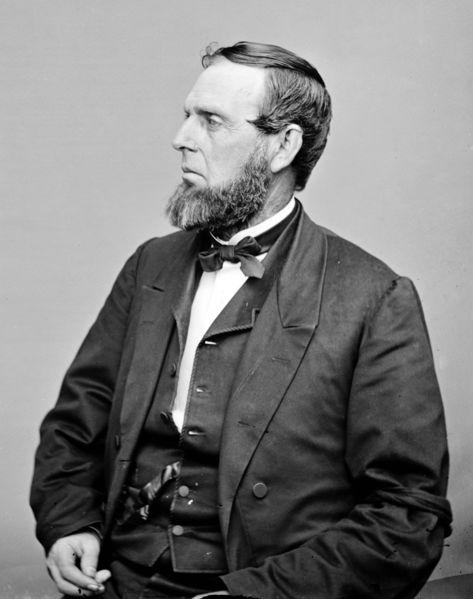
According to dubious sources, the urinal was first patented in 1866 by Andrew Rankin, an inventor and lawyer from New York. As far as I can tell, Rankin’s version was basically just a box with a hole in it. A slop jar, if you will.
Dr. Andrew Rankin, ca. 1866
Pioneer, Inventor, and Urine Freak
Thereafter, numerous attempts were made to improve upon the urinal, many of which are excruciatingly detailed on the United States Patent and Trademark Office website if you know where to find them.
In 1882, E. Francis Baldwin wrote in his patent application that “terminal drippings of urine continually fall on the edge of the bowl and run down the outside . . . . The nature of this deposit, owing to its consistency and adherence, and from its pervasive, pungent, and foul odor, renders it exceedingly offensive, and is the chief cause of the offensive smell in hotels or other public places where urinals are constantly in use.”
Baldwin’s solution was to add a flange to the urinal basin such that (I swear to god) “any drip falling on the top of the flange . . . will run down the front of the same, and, being prevented by gravity from running up the back of the flange, will thence drop from its lower edge directly onto the floor, or into a box of earth, sawdust, or disinfecting material that may be placed on the floor to receive it.”
Thus in 1882 we may conclude that urine on the floor was simply accepted as a way of life, much like small pox and erectile dysfunction. Think how far we’ve come.
Baldwin’s diagram of his proposed urinal looked oddly like an underwater diving helmet of the Jules Verne variety.
The E. Francis Baldwin
Underwater Urinal, ca. 1882
Two years later, in 1884, Albert B. Pullman of Chicago submitted a patent application with this introduction:
“A fault of all urinals as now constructed is that the basin is placed too high, rendering a drip-pan upon the floor necessary to prevent the fouling of the apartment. This is especially noticeable in railway cars, where the unsteady motion greatly increase the difficulty of using, though it exists in a greater or lesser degree under all circumstances.”
Pullman’s urinal had lovely sea-shell geometric lines, was detachable so that “it may readily be detached from the wall and carried out of its apartment, and after cleansing be readily replaced in position,” and basically sat on the floor to catch the drips. By the looks of it, I’m sure it sent piss absolutely everywhere.
Albert P. Pullman's
"Sea Shell" Urinal, ca. 1884
When water-flushed urinals became in fashion, it was common for the “flush water” from urinals to leap out of the basin and onto the urinator, an experience that was surely more dramatic than the unpleasant but sometimes subtle effects of the urine rebound effect.
Unblinkingly targeting the fears of the day, Thomas H. Hutchinson of Brooklyn developed a “Urinal-Pan” in 1898 that “provide[d] for so flushing the urinal-bowl that all danger of splashing on the clothing will be avoided.”
Sixteen years later, in 1914, Stephen D. Baker of New York submitted a patent application with this telling recital about extant urinals and the disappointing failure of the Hutchinson “Urinal-Pan”:
Baker’s urinal bears an uncomfortable resemblance to a vulva, and doubtless it was never taken seriously by the urinal elite. It strikes me that its principle flaw lies in its failure to consider the AIM Quotient (see sec. 5 of Smith Memorandum, supra). Just as God managed to do with the vagina, the first step is to make the hole big enough for what you’re trying to do with it.
Stephen D. Baker’s
Anatomical Urinal, ca. 1914
* * *
Remarkably, in 1938, a full 33 years after Einstein penned the special theory of relativity, and approximately 139 years after the invention of the cotton gin, the tantalizing problem of the urine rebound effect remained unsolved.
* * *
That year, a stunning convergence of geometry, fate, and porcelain vaulted a young man from Detroit onto the black-and-white tiled stage with a urinal design that modernized bladder evacuation for decades to come.
The young man was Harry G. Coordes, and he revolutionized the urinal with a specially designed parabolic back-splash area he called a “splash back” that, combined with border flange around the sump, “effectively prevented [urine spray] as well as [flush-water] splashing over the rim or side margins . . . .”
Harry G. Coordes's
Parabolic Back-splash Design, ca. 1938
Coordes’s urinal model is basically what is used today for most urinal designs. Yet, while Coordes certainly improved upon prior designs, no self-respecting man with half a penis would say that the urine rebound effect has at all been ameliorated to any reasonable degree.
Herbert V. Kohler, Jr. designed a contemporary-looking urinal circa 1988, but it did not improve upon early models as far as I can tell.
In 1994, a team of scientists from Cal-Tech used declassified stealth technology as a model for the back wall of the toilet, reasoning that an irregular geometrical surface of the type that would reduce the deflection of radar waves could be useful in deflecting urine in directions other than back at the urinator. This turned out not to be the case and the project was scrapped.
* * *
THE SPLATTERLESS URINAL: A CHIMERA
Four years later, in 1998, which was like forty million years after the first human ancestor pissed upright in the grassy plains of the African savanna, Roger H. Tilton and Robert Hayes, both of Seattle, Washington, were awarded a patent for a “Splatterless Urinal.”
Patent Abstract for the "Splatterless Urinal"
The patent application reads:
“As a natural consequence of [standard urinal] designs, there is a splattering of the urine streams due both to the geometry of the wall which is the natural target of the urine stream and because conventional urinals do not have adequate means to confine the urine to the flushed area. The resulting splattering produces unclean, unsanitary conditions in and around the urinal area and on the body or clothing of the urinator.”
While Tilton and Hayes clearly understood the problem, their urinal design looks like Artemus Gordon’s umbrella. Sadly, it is a creative effort of profound idiocy.
The Tilton & Hynes "Splatterless" Urinal, ca. 1997
These men did not comprehend what even the earliest urination experts have understood, which is that the AIM Quotient and actually hitting the f*cking target to begin with is inherent in the problem. If aim were not an issue, the Tilton and Hayes design would be ingenius.
Unfortunately, a urinal consisting simply of a modest hole three feet off the ground would have disastrous results. If you hit it–fine. If you missed it, you’d need a mop. Truly, the ideal back-splash basin for a urinal is probably something akin to the width and the “give” of an elephant’s ear with a trough the size of a basement freezer.
Today, many new urinals come with fascinating features designed to flush automatically, or save water, or talk to you during urination, or read you the news while you are peeing, and some new urinals even indicate a small target for the urinator to shoot for to reduce the urine rebound effect. However, in general, the shape and basic geometry of the urinal has not evolved dramatically since the time of Abraham Lincoln, who according to his wife’s memoirs, absolutely refused to do any manscaping whatsoever.
Outside of the Coordes parabolic backsplash, about the best any urinal scientist has been able to do to reduce the urine rebound effect is to recommend the placement urinals at varying heights from the ground to accommodate urinators of all sizes.
My Workplace Urinals.
I Use the One on the Left.
THE URINAL: A FAILED EXPERIMENT
In the final analysis, it may just be time to concede that the urinal is simply a failed experiment in the wet and tacky history of indoor bodily-waste evacuation.
Absent an unforeseen advancement in our understanding of particle physics and fluid dynamics, the obstacles facing the development of a truly splatterless urinal may in fact be insuperable. And this perplexing failure in the golden realm of human urination indisputably has broader implications on humanity as a whole.
“Our inability to resolve The Golden Paradox® is a sad commentary on the ability of science to address our world's deepest problems,” said Smith--who then lifted his leg slightly, adjusted his hairless testicles, and coughed dispiritedly into his fist.
Indeed, it has become apparent that the ultimate success of science in its quest to discover and comprehend all the physical processes of the universe will in fact be predicted in large part by the success of those elite few, the proud and undaunted, the tireless, the slightly moistened, the venerable Urinal Physicists of Earth, on their lonely journey to solve The Golden Paradox®.


 When I Have Fears I May Cease to Be: take a trip to an Asheville cemetery with a Wolfe aficionado to stand at the grave of beloved American writer Thomas Wolfe; read from his great works and taste the honeyed warmth of Scotch on your tongue as an exquisite October night falls in the mountains of North Carolina. Dedicated to rose-lipt maidens and lightfoot lads.
 Bryan's Blood People: an endearing short story about the struggles of a suburban South American family facing disease and mortality. Awarded First Prize for Realism in a Short Story by the Literalism in Fiction Council, Summer 2007.
 Beware the False Prophet: an exploration of mass hallucination in the religious context, along with several elegant lithographs of Yahweh communing with startled humans and various plants of antiquity. Also reveals for the first time what the abbreviation I.N.R.I. means (in case you ever wondered).
 The Age of Reason Lost: continuing with our theme of religious appreciation, this charmingly esoteric piece of delicate philosophical writing probes with great subtlety the mysteries of life, the universe, and everything. Spoiler alert: this article answers the ultimate question.
 The Scarlet Letter: examines in excruciating detail the "partial-birth abortion" debate and concludes that Congress is a collection of pandering, scientifically illiterate troglodytes. I predicted in this piece that the Supreme Court would declare the Partial-Birth Abortion Ban Act [sic] of 2003 unconstitutional, but I was dead wrong.
 This View of Life: a tribute to one of my favorite scientists, Stephen Jay Gould (R.I.P.), and some inebriate musings about The Tap Room in Hickory, North Carolina where my inebriate friends go for pub chips and Brown Mountain Light.
 The Perils of Vegetarianism: truly, a diet without meat is worth aspiring to, but believe me that shit is difficult. In part three of our series on special dietary concerns, we explore the life of the fast-food vegetarian and discover what it is like to have no meaningful options.
 Blue Ridge Mountain Blues: a biographical piece about bluegrass legend Doc Watson and old-time music from the mountains of North Carolina, where few people can read and even fewer people can spell.
 Bessie Crim and Walter and Charles: this is a short story written by my father in 1994 that should have been published somewhere but wound up folded into an old book and forgotten for 13 years. Sadly, he no longer writes; the world has lost a great storyteller.
 And finally: The Golden Paradox. Truly your faithful author's magnum opus, this article contains a detailed history of the urinal from slop jar to present and explores the vesicle-shrinking complexity of the physics of urine splatter, all in the delicate context of science's battle for preeminence as the chief discipline of ultimate knowledge and understanding. Dedicated to my dear friends in R & D at American Standard.